
 5.4/10
 21%
21%
 41%
41%
 35%
35%
 2.5/5
2.5/5
 58%
58%


I was a huge fan of He-Man and the Masters of the Universe (1983-85) and it’s sister (or should that be cousin?) show She-Ra: Princess of Power (1985) when I was younger. My brother and I had all of the toys – he was He-Man and I was Skeletor and we could play for hours recreating stories from the cartoons.
I don’t know if I saw Masters of the Universe when it was released in cinemas in 1987. Judging by the box office databases, almost nobody else did either. If you look it up today, tracking sites claim it made a grand total of $316 internationally — which means its entire global audience outside of America could have comfortably fit on an iconic Routemaster double decker bus. While the real domestic figure was a slightly better $17 million, it was still a massive bomb that helped sink Cannon Films into bankruptcy. I certainly remember watching it at home though (it could have been a video rental or TV showing, I don’t know) but what struck me (and still strikes me today) is how not like He-Man it was.
Move to live action aside, the film seemed to take everything that made the cartoon so special — relationships, comedy, moral messaging and even locations — and decided to take that, chuck it in a bin, set fire to it and then stomp on the burning embers.
Now, I’m not saying that MotU is a “bad” film in general, what I am saying is that it’s a bad He-Man adaptation.
But with the new film being released this past weekend (which I haven’t been able to see yet) I thought I’d revisit a very odd entry in the He-Man franchise.
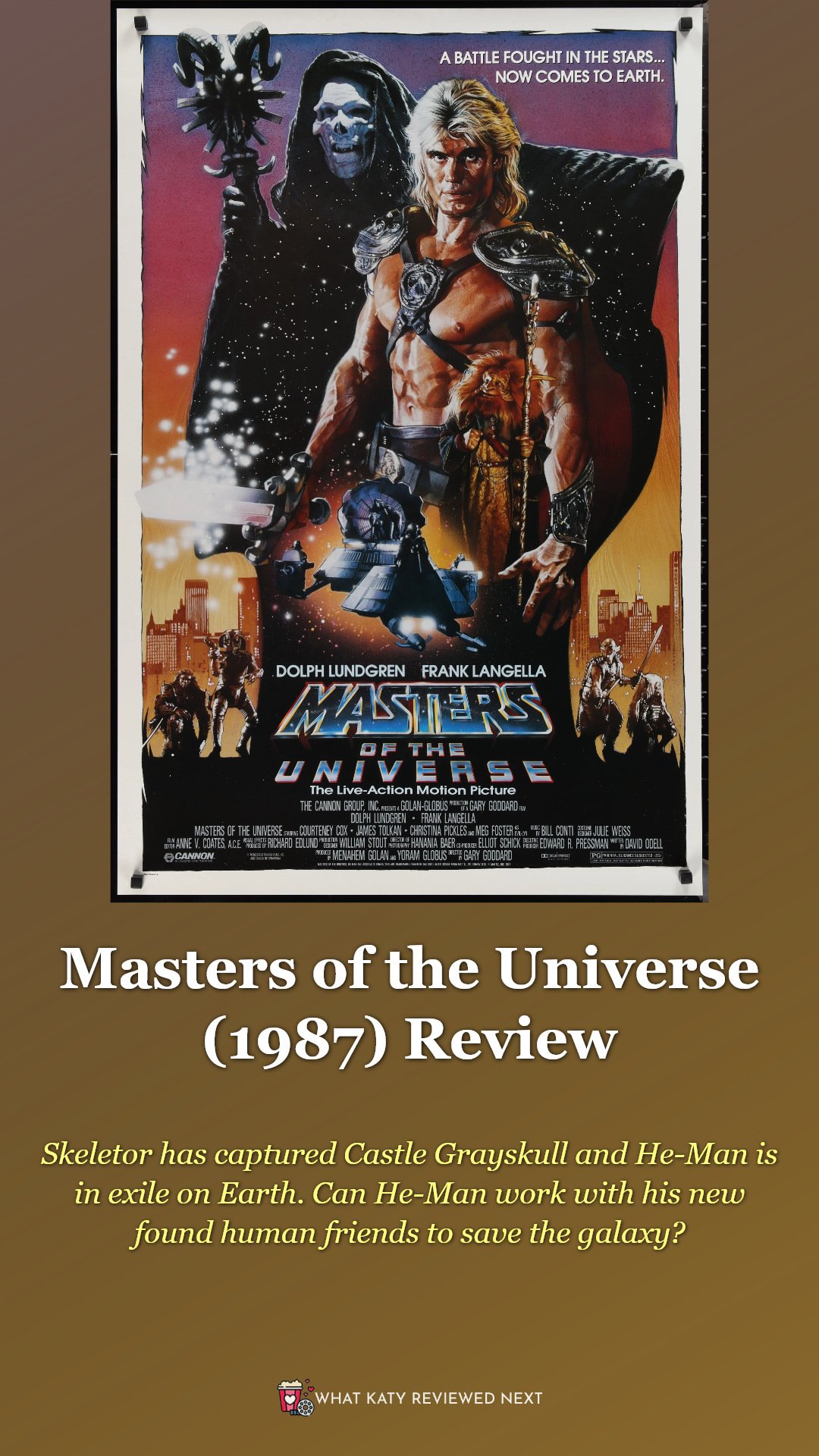
What Is Masters Of The Universe About?
We’re dumped into the movie at Castle Grayskull, current home of the evil Skeletor. How do we know he’s evil? He’s a skeleton so he must be!
Skeletor’s invaded Eternia and captured its seat of power, Castle Grayskull. In the process Eternia’s fighting forces have either been captured or fled leading Skeletor to a complete victory over his most hated foes.
Along with the Castle, Skeletor has also captured the Sorceress of Castle Grayskull and trapped her behind a forcefield which is transferring her magic to Skeletor, aging her in the process. Skeletor needs the Sorceress’s power to add to his own as he attempts to receive the power of the cosmos and become a God.
How is he going to do this? The Great Eye of the Galaxy is due to align directly with Castle Grayskull at moonrise and the combined power of Skeltor and the Sorceress will be able to open the Eye and allow Skeletor to take in the power of the universe.
Skeletor’s armies are sent out to capture He-Man, the protector of Eternia, but are unable to do so and in the process He-Man meets up with Man At Arms and Teela (although I spent the entire film thinking they were calling her “Tina” as the sound quality and dubbing is awful) and then the 3 of them rescue Gwildor.
If you’re a fan of the He-Man cartoons and are wondering who the heck Gwildor is, it’s because you won’t have heard of him before. He’s a character made up for the movie to provide comic relief and further the plot but I think mainly he was a replacement for Orko as the effects required to include a floating wizard would have been far beyond the budget and technical capabilities of this film.
It turns out that Gwildor (Billy Barty, The Krofft Supershow – 1976) accidentally worked for the witch Evil-Lyn who, if you couldn’t tell by the name, is evil and on the side of Skeletor. Gwildor had created a key that has allowed Evil-Lyn and Skeletor to open the doorway to the comic power that Skeletor is seeking to absorb.
Luckily, this isn’t the only Key in existence as Gwildor is able to use his prototype Key to send He-Man, Man At Arms (John Cypher, Hill Street Blues – 1981-98), Teela/Tina (Chelsea Field, NCIS: New Orleans – 2017-21) and himself out of harms way as Skeletor’s forces hunt them down.
The problem is that Gwildor didn’t have enough time to configure the Key correctly and instead of sending the group to a safe space on Eternia, they end up across the galaxy on modern-day (late 1980s) Earth.
As they were fleeing, they were separated from the Key which is discovered by two teenagers, Julie (Courtney Cox, Friends – 1994-2004, Scream – 1996) and Kevin (Robert Duncan McNeil, Star Trek: Voyager – 1995-2001), while Julie is visiting her parent’s grave.
Kevin is a wannabe musician and on playing with the Key he finds it can play musical notes and assumes it must be some kind of Japanese synthesizer as it’s so advanced. The pair head to their high school were Kevin is performing one final soundcheck before their graduation ball the following night.
It’s here that he decides to properly test out the new synthesizer he’s found (because obviously every graveyard contains musical equipment that has magically fallen from the sky and it’s totally normal) so he holds it up to a microphone and begins to create various musical tones. This causes “music” to be played and also bright lights to appear that swirl around the teens as they stare in wonder (instead of fear) at the device they found.
The Key is actually an instrument, tied in to the cosmic background music of the universe and playing it, unbeknownst to Kevin, has allowed Evil-Lyn to track its position and she sends a squad of “elite” warriors to find and capture the Key and He-Man.
The “elite” warriors that are sent — Saurod, Blade, Beast Man, and Karg — are probably the most hapless creatures to ever exist and they fail in their mission leading Skeletor to disintegrate Saurod (so much for the kid-friendly cartoon, eh?) and send Evil-Lyn to Earth to finish the job properly.
What ensues is not just a battle for Kevin and Julie’s home town, but a battle that crosses the galaxy to Eternia and maybe the entire universe itself.
Will He-Man and his new friends be able to take on Skeletor if he’s able to become a god? Or will Skeletor become the true Master of the Universe?
Read on for my thought on 1987’s Masters of the Universe — warning: Slight spoilers ahead!
The Good
While this is a terrible He-Man movie, it’s a thoroughly enjoyable science fiction movie. Frank Langella (Frost/Nixon – 2008, The Ninth Gate – 1999) as Skeletor rips all the scenery from the walls and chews through it like a man possessed.
Considering he’s behind an rather immobile (and extremely rubber) mask, he really shines as the evil menace that Skeletor represents.
Another stand-out is Meg Foster (Leviathan – 1989, Ravenswood – 2013-14) as Evil-Lyn who really understands the assignment and obviously did her homework on her cartoon predecessor.
And I know that Dolph Lundgren gets a lot of hate for this wooden acting and delivery but when you take the script into account I think that explains a lot – his previous big films (Rocky IV – 1985, View To A Kill – 1985) were hardly known for their Shakespearean levels of dialogue either. Lundgren does well with the material he’s given (which is sparse to say the least) and while he’s not as chatty or eloquent as his cartoon counterpart he gets the job done reasonably well.
And the set design (on Eternia at least) looks good. What little we see of Castle Grayskull does look very nice and in keeping with the aesthetics of the cartoon but it was disappointing we didn’t get to see its exterior in any meaningful way. The skull like frontage with the entrance being the gaping mouth is an iconic piece of pop culture history and should have been a main anchor of the scenes on Eternia.
The Bad
I’ve already touched on the script and how bland it was but it also comes across as being written by someone who had never even seen the He-Man cartoons before! The writers had somewhat of a mixed bag of experience and connection to the franchise.
Roger Sweet is given a writing credit despite not being a writer — he was the creator of the original He-Man toy that spawned the cartoon series (a vehicle used for Mattel to sell He-Man merchandise).
We then have Gary Goddard whose sole writing credit before MotU was Tarzan the Ape Man in 1981.
And finally we have David Odell, arguably the most experienced of the bunch who has prior credits on The Muppet Show (1979-81), and screenplay credits for Dark Crystal (1982) and Supergirl (1984) and I think it’s his work on the superhero movie that landed him the job.
The problem is that if you don’t know the backstory of who He-Man or Skeletor are then these characters are meaningless — you have no connection to them, don’t understand their motivations or understand why the two are moral enemies.
As the start of the film literally plonks you into the middle of the action post-taking of Eternia with no exposition at all you’re not given any clues as to what the heck is going on.
Usually I hate lengthy explanations that assume the audience are dumb but we’re given nothing to work with at all — and as it’s been years since I’ve seen the cartoon it’s almost like I am in the position of a new viewer who’s left scratching their heads and wondering what is happening.
That being said, I have enough of a core memory of the cartoons to know that is is not what He-Man is.
Throughout the film He-Man uses guns instead of his sword (the powerful Sword of Grayskull) and he kills black cladded soldiers (that are totally not trying to copy Star Wars Stormtroopers in any way) with no remorse.
Remember: This is a character that was famously against violence and only used it as a last resort and most certainly never killed any one in the cartoon, let alone mowing down rows of soldiers with a blaster.
The only excuse for this is that these Black-cladded soldiers are robots, which is kind of hinted at as they spark when shot, but as it’s never explicitly explained then He-Man is essentially a mass murderer.
Nice.
The script’s complete disconnect from the source material hits its peak in the final act, where a grumpy local cop (James Tolkan, Back To The Future – 1985), drops not one, but two “Shit’s” right into the middle of the action!
For a franchise built on squeaky-clean Filmation morals where characters literally lectured you on good behaviour before the end credits, hearing a live-action character swear is fundamentally jarring and left me sitting there wondering if I had actually heard what he had said correctly (I had. Both times.)
While the BBFC applied its usual standards to the film, forcing cuts to keep its PG rating for the 1987 UK cinema release, the US release famously squeaked through with no cuts at all. A young American audience was presented with swearing in a film from a franchise actively built on clean behaviour — proving once again that the writers had absolutely no idea who their actual audience was.
The Ugly
The film’s budget was only $22 million, less than half the budget that 1978’s Superman was allotted, and as a result the special effects suffered massively.
Most of the practical effects are fine, just fine — nothing stands out about them, and the visual effects of when Skeletor is being transformed into the God-like Master of the Universe still holds up well today, as do his beams of “magic” power.
But one of the scenes that really took me out of the film completely was the chase between He-Man and another one of these Robot-Not-Robot Black Soldiers.
Some of Skeletor’s forces arrive floating on what I can only call “dustbin lids” with a couple of lights slapped on them. They hover around the town, above the rooftops in some of the most unrealistic optical compositing I have seen.
At one point He-Man defies gravity by flying upside down — I think he’s flying upside down, we just see his head flipped so it’s coming down from the top of the screen which is random — and I just started laughing hysterically at how crap it looked.
We also have the fight scenes where He-Man finally uses his sword.
The first one is edited in such a way that you can’t really see what is going on. I think this was done to speed up the action and make it seem like the actors knew how to actually sword fight — plus it’s a pretty bad fight at the best of times. But this gets even worse when it comes to the final “boss battle” between Skeletor and He-Man.
I’m not sure what happened, but instead of the fast-paced cuts we had in the earlier fights, we now have a very slow and plodding action sequence through set-move after set-move that looks like it was filmed with the actors feet in molasses.
This has the effect of making the viewer wonder what is so special about He-Man and how powerful this so called “Master of the Universe” version of Skeletor actually is.
I guess that because Lundgren was being used for all the shots instead of a stuntman they had to be careful that he couldn’t get hurt but couldn’t they have used rubber swords? And while Frank Langella was 49 at the time of filming (which isn’t old by today’s standards — just look at what Tom Cruise gets up to at over 60), with Skeletor’s mask they could put anyone in that costume and we wouldn’t know. But Langella wanted to play as much of Skeletor as he could and so did most of his own stunts which presumably slowed the action down somewhat.
The whole thing led to a bit of an anti-climax with the final fight not being anywhere nearly as satisfactory as it needed to be to justify the Galaxy/Universe ending powers that Skeletor was supposed to have absorbed.
Final Thoughts
I didn’t dislike Masters of the Universe as a film, but I did dislike it as a He-Man film.
The cartoon had been off TV for a couple of years and given the fact that the cartoon only existed in the first place for Mattel to sell He-Man toys, I can easily see that they were desperate to get something, anything on screen in order to be able to release a new line of He-Man merch in order to make more money.
The tone of the film — both visually and in terms of script — does not lend itself to being a kids movie, let alone one based on a cartoon series that was happy and light in tone, a cartoon that always ended in a moral message telling kids not to be bad (which was to get around the show being classed as one big advert) and had the characters happily laughing together at the end.
What we had instead was something that wanted to be Terminator (1984) crossed with Superman (1978) with a hint of Star Wars (1977) using an established I.P to do so and as a result it misses every single audience group it could have possibly targeted.
I’m not saying don’t watch this film, I’m just saying don’t be disappointed when Prince Adam, Cringer and Orko don’t break the fourth wall in order to tell you not to shoot Black Cladded soldiers because that’s bad.
Watch this film if you’d be happy to run into a half-naked man in a back alley and would ask no questions about his attire what-so-ever.
 Apple TV Store
 Google Play Movies
 Fandango At Home
 Amazon Video
 MGM Plus