

 7.0/10
 87%
87%
 74%
74%
 77%
77%
 3.4/5
3.4/5
 70%
70%


Before watching Backrooms (from first-time director Kane Parsons) I had a basic knowledge of what the backrooms were: an internet meme where a space exists just outside our own reality filled with a maze of rooms with creepy entities roaming around.
It’s a bit more than that (I wrote a breakdown of creepypasta and the backrooms if you want to check that out) but you don’t really need to be deep in the backrooms lore in order to watch the movie.
I had been a bit concerned with the wall-to-wall adverts for this film I was seeing constantly on YouTube — usually when I see this number of adverts for a film they’re trying to push a lemon so I was a bit concerned with what I would be facing.
I was also a bit concerned when the film started: a handheld camera, found footage style showing the interior of the backrooms before strange events start happening.
“Here we go” I thought, “yet another found footage movie. Yawn!”
But Backrooms isn’t that and yet, in the spirit of the backrooms themselves, it is.
What’s Backrooms About?
The film centres around Clark (Chiwetel Ejiofor – 12 Years A Slave – 2013, Doctor Strange in the Multiverse of Madness – 2022) a down-on-his luck architect who’s struggling through life and working in “Captain Clark’s Ottoman Empire”, a discount furniture warehouse.
Through a session with his therapist Mary (Renate Reinsve, White Boys – 2018-21, Butterfly – 2026) we find out that Clark went through a bitter divorce with his wife after his late nights at work and drinking strained their marriage to breaking point.
Clark is resentful of his wife still being at university studying law and feels that she’s enjoying student life while he’s forced to work at a job he hates to cover her tuition fees.

Clark spends his days sitting in the store waiting for customers that never come, filming cheap TV ads dressed as a pirate (even though it’s pointed out to him he should be a Sultan given the store’s “Ottoman” name) and sleeping in the store after losing HIS house in the divorce.
The store is pretty run down and as a result there are frequent issues with the electricity with the lights going off intermittently, random flickering and general power surges.
After calling in an electrician, they find that random breakers have been installed at an odd angle in the fuse box but they don’t seem to be connected to anything. One evening, while watching TV in one of the store’s beds the power starts flickering again so Clark heads down to the lower showroom to fiddle with the fuse box and turning all of the lights off he sees a strange glow coming from the middle of the wall.
Clark investigates and discovers that he can noclip through the wall into a new space — a massive series of rooms with furniture clipping through the walls and floor, signs with backwards text and a general feeling of everything being strangely familiar but strangely wrong at the same time.
Clark returns to talk to Mary about his findings and he shows her a map of the space he’s discovered. Mary is of course sceptical and wonders if Clark has started drinking again but he insists he’s been sober for days.
Frustrated, Clark enlists the help of his assistant store manager Kat (Lukita Maxwell, Generation – 2021) and her boyfriend Bobby (Finn Bennett, True Detective 2024) as he has access to a video camera. They take the camera into the backrooms and begin to explore but as they go deeper into the space they realise that something is stalking them.
Mary, fearing for Clark’s safety and sanity, heads to the furniture warehouse and finds her way into the backrooms. Here, in a space that both exists but doesn’t she must face her darkest inner fears and something much, much worse.
The Good
The sets of Backrooms are fantastic and the use of a huge practical stage set really helps the oddness and horror of the backrooms come to life on the screen. The 30,000 square foot set even caused the crew to get lost so that just heightens the feelings of just how massive and ominous the backrooms are.
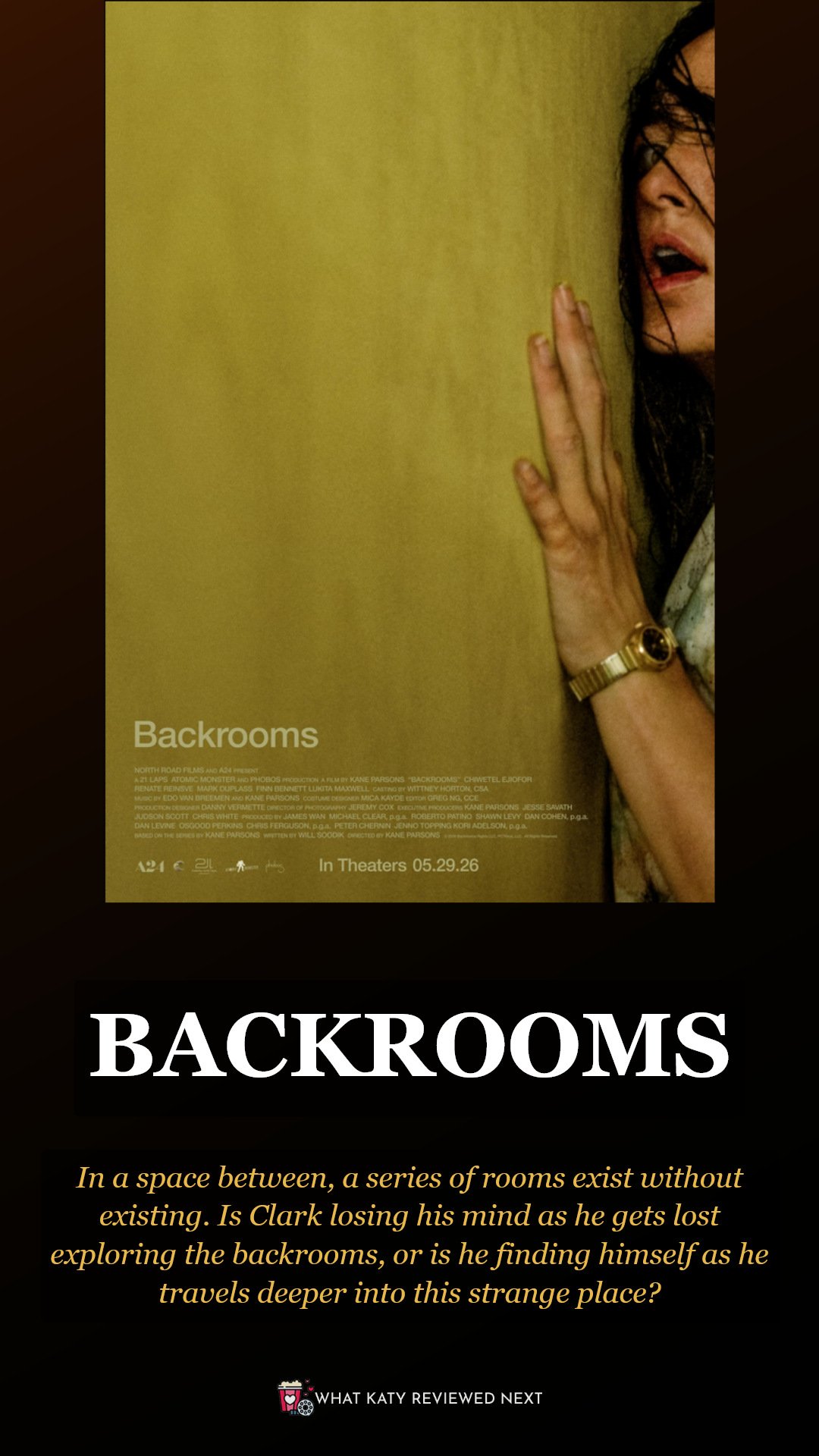
Another thing I thought that was really well done was the lighting. I was initially worried that the theme of the trailers (muted yellow sets, muted yellow lighting) would carry on throughout the entire film and while that is the theme of the main backrooms levels, we do see other sub-sections and levels in the film.
Each of these sections has its own feel to them both in terms of set design and lighting. These changes bring variety to what otherwise could have been a bland experience — although the whole point of the upper levels of the backrooms is to be bland!
And finally, Ejiofor shines as the slowly unravelling Clark. He’s an unreliable narrator at the best of times. His one-sided view of the dissolution of his marriage speaks volumes about the type of man he truly is and when he finally realises his true nature and is made whole it’s his ultimate undoing.
The Bad
While Ejiofor’s performance anchors the film, the narrative scaffolding around him occasionally falters. There are a few issues I have with the film and I think it’s mainly due to the writing.
Will Soodik (Ash vs The Evil Dead – 2016) joins director Kane Parsons as writer and both have limited writing credits and I think that shows itself in the script.
There’s an old adage in film making of: “Show, don’t tell”.
The idea is that the writers, directors, composers and editors all come together to paint a picture that shows the audience the character’s thoughts and feelings, allowing us to put us in their place and understand what they’re thinking without explicitly being told.
An example of this would be Bella breaking up with Edward in Twightlight (2008). We’re not told she’s sad, we’re shown. As silly as the scene is, the shot of Bella sitting in a chair moping while the seasons change outside her window tell us, the audience, how devastating this breakup was to her. If she had just turned around to her Dad and said “We broke up, I am devastated” no matter how well acted the scene was it would have nowhere near the impact as the seasons-changing scene.
With Backrooms though, the writers take “show don’t tell” to its most extreme and then later throw it out of the window like the concept never existed.
Slight spoilers for Mary’s character in this section:
Throughout the film we’re shown a series of vignettes depicting Mary’s childhood. There’s very little dialogue in these scenes and no explanation of what is happening.
We can in infer though that Mary’s background was extremely troubled with a mother who was mentally unstable and this is presumably what led her to become a counsellor — to try and fix other people because she couldn’t fix her mother.
This, in the most part, is well done and we don’t need dialogue to explain what is unfolding on screen they’re showing us Mary’s traumatic childhood without shoehorning it in to the story by having her talk to her own therapist or best friend about it.
And we get towards the end of the film though, the whole concept of “show don’t tell” goes completely off the rails and we’re given extremely long and expositional dialogue explaining what is happening and why when we could have been shown it without having it slapped in our faces.
Another place where I feel that the writing collapses in on itself is the ending.
To me it seems to be tacked on in order to provide the audience with a definitive resolution and closure which is odd for the type of film it was.
The backrooms are liminal, a space in between places, our world and the unknown. We’re not directly told what the backrooms are, why the backrooms are or how the backrooms came to be (there are things hinting at their origins) and it’s this not knowing that is the point.
Having such a definitive ending (even if it is open for a sequel) with loose ends neatly tied up is at odds with the meaning behind the backrooms in the first place.
Maybe I’m thinking about it too much but personally the ending seems like it belongs to another film entirely.
The Ugly
When the film starts, we view events through the lens of a handheld camera belonging to someone investigating the space. We’re then abruptly jolted into the “real world,” where the cinematography shifts to a traditional, third-person narrative.
Separating the two realities with distinct visual styles makes complete sense. The problem is that the film doesn’t stick to its own rules. Once inside the Backrooms, the camera perspective flip-flops wildly between found-footage first-person and cinematic third-person.
This identity crisis makes the movie feel disjointed. It’s as if it couldn’t decide whether it wanted to be a gritty, indie found-footage flick à la The Blair Witch Project (1999) or a sleek, studio horror film like The Conjuring (2013).
This stylistic instability ultimately broke my immersion, which is a massive shame for a world that relies so heavily on atmosphere.
Final Thoughts
Don’t get me wrong, I didn’t dislike Backrooms, quite the opposite!
While I do have some gripes with the writing and directorial choices, overall the film works really well with the material it has and first-time director Kane Parsons shines.
Parsons has been making short-form content on YouTube surrounding the backrooms since 2022 and so is well versed in the lore. There’s already talk of a sequel — not surprising as the film has already made over $100 million domestically on just a $10 million budget.
It does worry me that Parsons might get pigeonholed in the backrooms (or horror) genre if they leap into a sequel too quickly, he shows a lot of promise as a director and I would hate to see him become a “one hit wonder”.
Slightly disappointing ending aside, Backrooms is well worth a watch. While it’s not as flashy as some modern horror movies it makes up for its small budget with fantastic set design, lighting, smartly paced editing and a subtle musical score that brings eerie chills to the backrooms.
Watch this film if you often feel that the world isn’t quite right and that seeing large empty office spaces with flickering fluorescent lights fills you with existential dread.